Volleyball strengthens its place among the world’s leading
sports
as FIVB Board advances Strategic Vision 2032
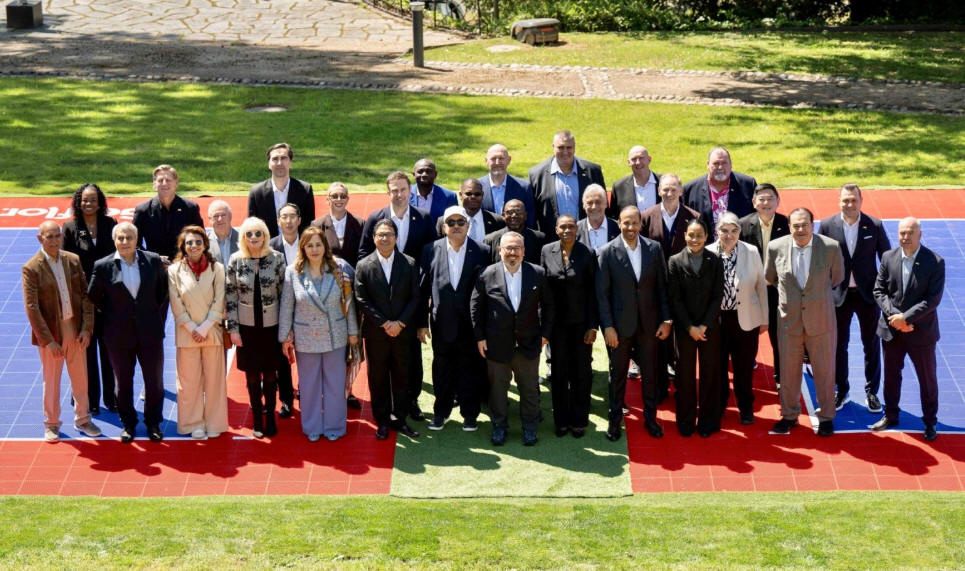
Lausanne, Switzerland, May 12, 2026.- The FIVB Executive Committee
and Board of Administration meetings took place at Volleyball House
in Lausanne at the end of last week, bringing together leaders from
across the Global Volleyball Movement to shape the next phase of the
sport’s growth around the world.
Guided by the ambitions of the FIVB Strategic Vision 2032,
discussions throughout the meetings focused on one clear objective:
making volleyball more accessible, understandable and affordable for
people everywhere.
That
vision was clear even before the meetings began.
Ahead of the opening session, members of the Board were able to
observe an air volleyball demonstration at Volleyball House led by
FIVB and Volleyball World staff. Having first originated in China,
where it continues to be hugely popular, air volleyball is rapidly
emerging as an exciting and accessible way for people of all ages
and abilities to enjoy the sport. Played with a lighter, softer and
slightly larger ball, the format encourages longer rallies, more
touches and more fun. Its simplicity and flexibility mean it can be
played almost anywhere – from schools and community centres to
public spaces and shopping malls – making it a powerful driver of
mass participation and a key tool in bringing volleyball to entirely
new audiences.
Opening the Board of Administration meeting, FIVB President Fabio
Azevedo highlighted the strong momentum currently being generated
across the sport worldwide and underlined the importance of
continuing to unite and empower the Global Volleyball Movement. He
also touched on some of the recent successes from across the
Movement. These included founder of the Brahmaputra Volleyball
League, Abhijit Bhattacharya, being recognised as the Global Winner
of the 2025 IOC Gender Equality, Diversity and Inclusion Champions
Award, Korean volleyball legend Kim Yeon Koung receiving the award
as Asia’s recipient, and beach volleyball Olympian Doaa Elghobashy
being recognised as an athlete role model for the Dakar 2026 Youth
Olympic Games.
Board members reviewed a wide range of developments across
international volleyball and beach volleyball, from governance and
sustainability to events, innovation and athlete support. Members
also acknowledged the passing of former CEV President and FIVB
Executive Vice-President Aleksandar Boričić, recognising his
longstanding contribution to the development of volleyball in Europe
and globally.
Key
governance discussions included updates on the FIVB Constitution,
Zonal Association restructuring, finance and audit matters,
Volleyball Empowerment initiatives, sustainability programmes and
National Federation categorisation.
In
addition, in line with the FIVB Board of Administration’s previous
decision to follow IOC Executive Board recommendations, and further
to the IOC Executive Board’s recent decision to no longer recommend
any restrictions on the participation of Belarusian athletes,
including teams, in competitions governed by International
Federations, Belarusian athletes and teams are therefore allowed to
return to participation in international volleyball competitions
with immediate effect.
The
meetings also included updates on the continued commercial growth of
volleyball through Volleyball World, alongside major international
events including Volleyball Nations League 2026, the FIVB U17 World
Championships in Chile and Qatar, the Beach Volleyball U18
Championships in the Netherlands, the Beach Pro Tour and
preparations for the Olympic Games Los Angeles 2028.
Board members discussed exciting progress towards the launch of the
Beach World Series, preparations for the FIVB World Congress in
Punta Cana later this year, and plans for an even bigger edition of
World Volleyball Day 2026 following the success of its inaugural
celebration last year, which reached more than 280 million people
across social media platforms worldwide.
Innovation and technology also featured prominently on the agenda,
including discussions surrounding AI initiatives and remote
officiating solutions designed to enhance the volleyball experience
for athletes, officials and fans.
The
Board additionally received an update from the FIVB Volleyball
Foundation, which recently approved five new projects across four
continents during its first Board meeting under President HRH
Princess Ayah bint Faisal – another important step in expanding
volleyball’s social impact worldwide.
Further strengthening collaboration and knowledge-sharing across the
sport, the FIVB Board approved that chairs of Continental
Confederation Referee Commissions will be invited to observe future
FIVB Rules of the Game and Refereeing Commission meetings as part of
ongoing efforts to enhance transparency, education and global
standards in officiating.
Board members also approved the creation of “The Volleyball Order”,
a new distinction set to replace the FIVB Grand Cross, recognising
outstanding contributions to the global development of volleyball.
Throughout the meetings, one message remained clear: volleyball’s
future growth will come from making the sport easier to understand,
easier to access and easier to play for communities across the
world.
As
the FIVB continues to deliver its Strategic Vision 2032, the Global
Volleyball Movement is working together to ensure more people than
ever before can experience the joy of volleyball. |